
Wealthfront occupies a useful corner of my financial life. It’s where I park money I expect to need soon, but not today, so it can earn a decent rate while it waits. When that money gets a real assignment, I can move it back to my everyday bank without much friction.
As of July 22, 2026, Wealthfront’s base Cash Account rate is 3.30% APY. In my experience, Wealthfront has beaten the rates I was seeing at other high-interest accounts more than 90% of the time I’ve used it. That is an observation, not a promise, and the rankings can change whenever rates do. A newer 0.25% APY boost for qualifying direct deposit and a funded investing account has made Wealthfront even more competitive for me; I’ll explain the requirements below.
The larger lesson is not which platform wins this month’s rate race. It’s noticing when a meaningful pile of money has been sitting on the bench for months because switching accounts sounded mildly annoying.
My short verdict: Wealthfront’s Cash Account is a compelling place for liquid short-term money once you understand the sweep structure and transfer rules. There’s no ongoing deposit requirement to earn the base rate and no stated cap on the balance that earns it. It is not a traditional savings account, though, and “no fees” comes with a few debit-card asterisks.
Current link status: I have a personal Wealthfront client-referral link, but I have not included it in this review while I confirm whether Wealthfront permits that link in a public article. There is no paid or referral link on this page.
First, the correction: Wealthfront is not a bank
The familiar FDIC limit is generally $250,000 per depositor, per insured bank, per ownership category. That is the ceiling most of us have in mind when someone says, “Don’t worry, it’s FDIC-insured.”
Wealthfront works differently because the Cash Account is offered by Wealthfront Brokerage, which automatically sweeps eligible cash across a network of program banks. You still see one balance on your screen. Behind the scenes, Wealthfront currently says it may allocate the money across as many as 32 unaffiliated banks and advertises eligibility for up to $8 million of pass-through FDIC coverage on an Individual Cash Account and $16 million on a Joint Cash Account.
“Up to” matters. The same $250,000 limit still applies at each program bank, and money you already hold at one of those banks outside Wealthfront counts toward the same limit. Wealthfront says customers are responsible for monitoring those overlaps. FDIC coverage also does not begin until the cash reaches a program bank.
For an ordinary balance, this may be background trivia. With a large balance—or outside deposits at a program bank—it becomes homework. The tradeoff is access to potentially much more eligible coverage than a single bank account could provide.
Yes, Cash Accounts can have routing and account numbers
These numbers were not always part of every Wealthfront Cash Account. Back when I first started with Wealthfront, there was no account number tied to my Cash Account at all. That’s no longer true today.
Today, funded Individual and Joint Cash Accounts with checking features can use routing and account numbers for direct deposit, bill pay, and compatible payment apps. Those ACH details do not work for wires, which use different instructions. Product details like these change, so confirm the current instructions in your own account before moving important money.
Having real numbers also means you’re not stuck handing some third-party linking service your username and password when another app wants to connect to this account. There’s usually a manual option for exactly that reason.
What I like in everyday use
The base rate has been refreshingly uncomplicated
The published 3.30% base APY currently applies to the whole Cash Account balance—no direct-deposit hoop, no minimum ongoing balance to babysit, and no paid subscription required. The opening minimum is $1, and the rate is variable.
That $1 transfer minimum created one tiny nuisance for me. I once moved 100% of my money out, then received a final interest payment of less than $1. Wealthfront would not let me transfer such a small amount, so the change sat there until more money arrived. It was not financially meaningful, just an odd edge case worth knowing if you empty the account completely.
Wealthfront also layers on temporary and conditional boosts. As of this fact-check, customers can earn an extra 0.25% APY by receiving at least $1,000 per month in eligible direct deposits and keeping a funded Wealthfront investing account. Wealthfront says that boost currently has no balance maximum and continues while both requirements are met. New-customer and referral offers have their own caps and expiration dates.
I keep three separate mental folders for these numbers:
- Base rate: what the account earns without a temporary promotion.
- Qualification boost: what normal financial behavior might sustain.
- Promotional rate: useful while it lasts, but not a permanent reason to reorganize my finances.
A promotion is dessert 🍰. If the base account is bad, whipped cream will not save dinner.
It shows the interest doing its job
Wealthfront shows what the account has earned and what it is on pace to earn by the end of the month. It’s a small design choice that does a surprising amount of psychological heavy lifting. An APY by itself is abstract—a percentage sign floating in space. A projection in actual dollars looks like an employee clocking in and doing the job you hired it for.
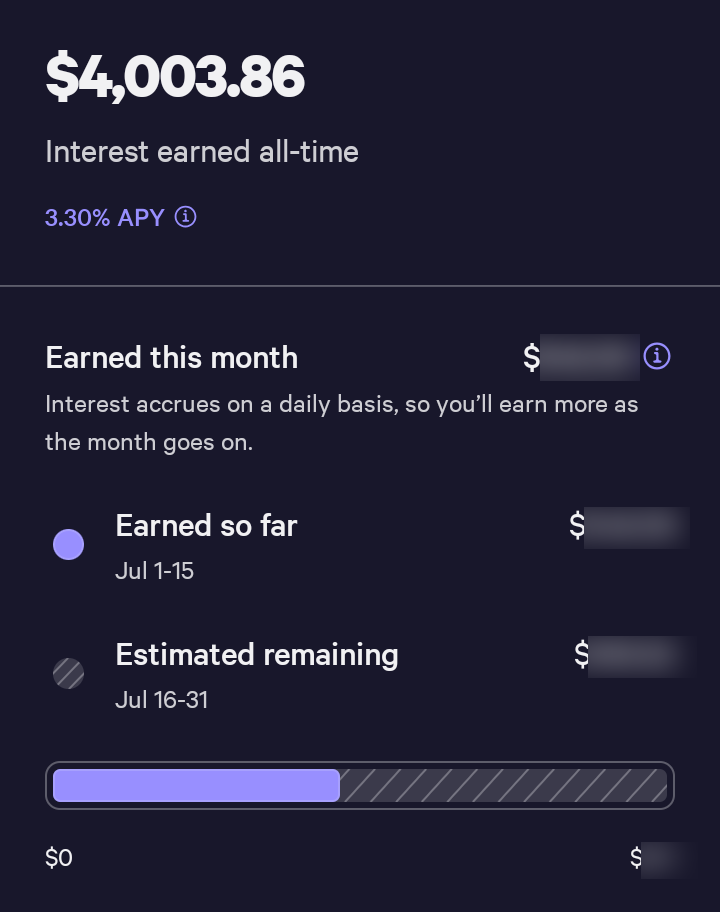
This matters most with a large temporary balance: house money, a tax bill, or savings for a major project. The gap between 0.1%, 1%, and 3.3% does not look dramatic in tiny type. Convert those rates into monthly dollars, though, and the lazy account suddenly has some explaining to do.
I mean that literally. I once left a house down payment sitting in a different “high-interest” account that mostly wasn’t, and it cost me more than $10,000. Here’s the six-figure version of that mistake if you would like a little motivation before opening another account.
Transfers have been fast for me
In my experience, transfers from Wealthfront to SoFi have often arrived the same day and almost always by the next one. The screenshots below show one $2,700 ACH transfer that left Wealthfront and appeared at the receiving institution on October 20, 2025. Same-day ACH has happened for me, but it is not the norm.
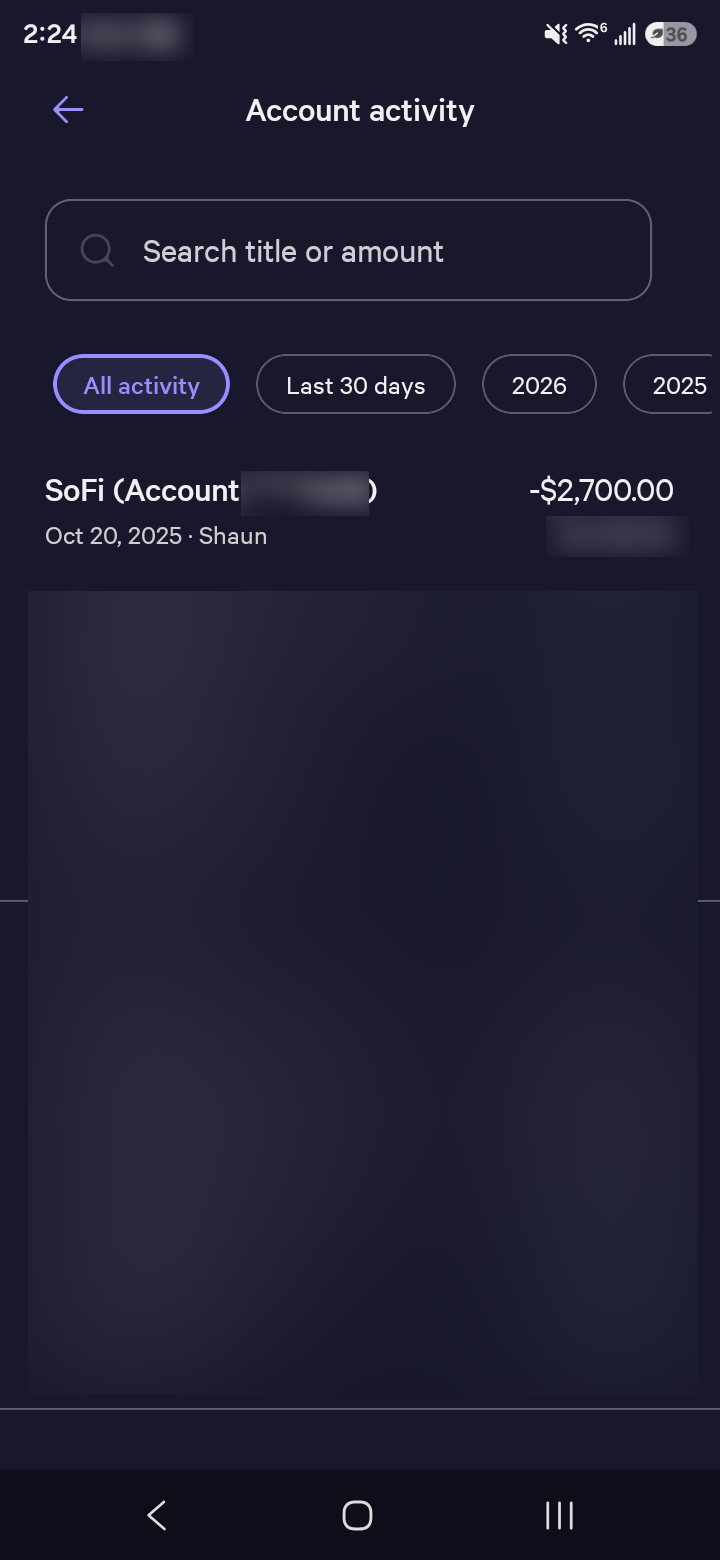
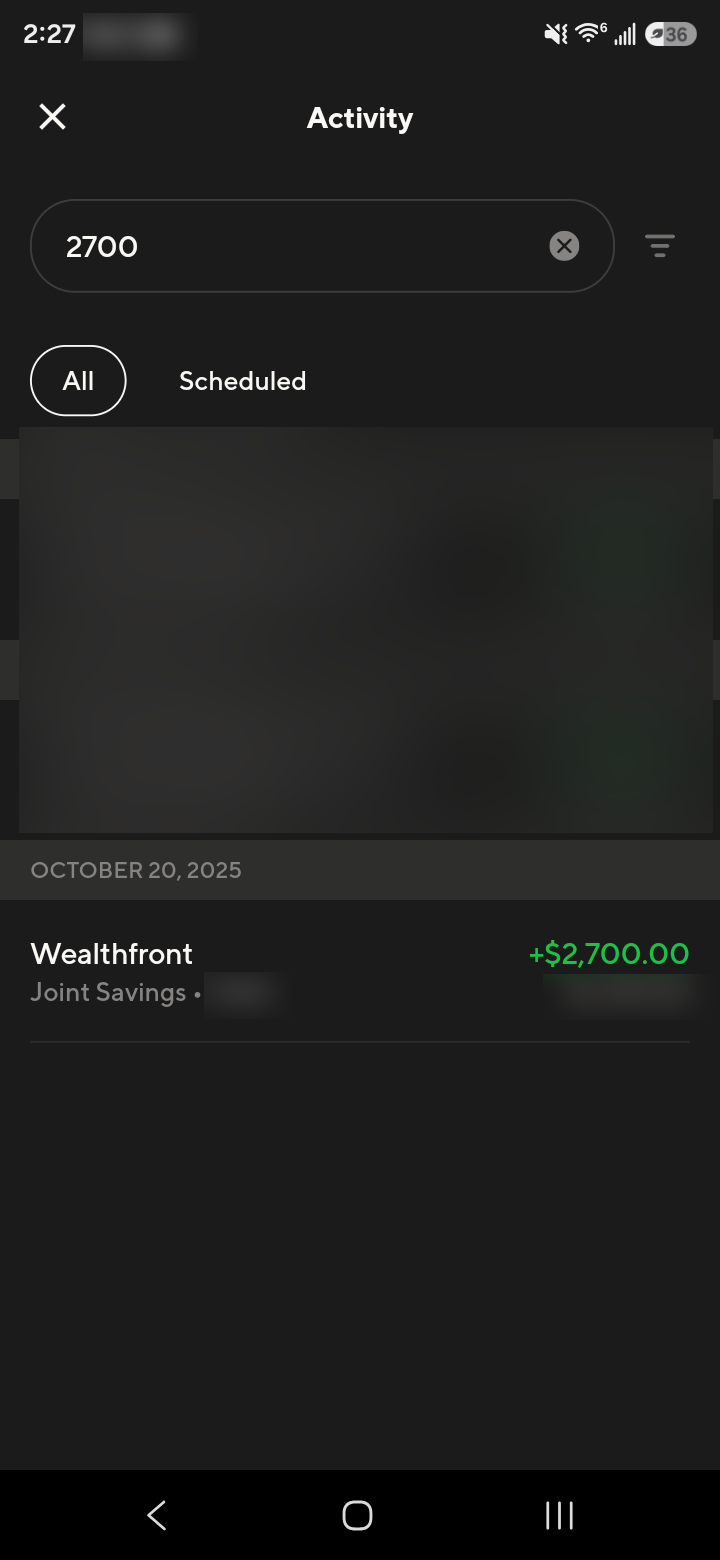
Officially, Wealthfront says eligible outgoing transfers over the RTP or FedNow networks usually arrive within minutes, while ACH transfers usually arrive by the next business day. The receiving institution still controls when funds become available. SoFi, for what it’s worth, has been about as quick as ACH gets.
Going the other direction has typically taken about a day for me, although Wealthfront may take several days to mark a recent deposit fully available. That later “settled” or available date is not normally the first day it earns interest. Wealthfront says pending funds included in the total balance earn interest even while a security hold prevents spending or withdrawal. Its disclosure adds one important nuance: interest and pass-through FDIC coverage begin after the funds reach the program banks, which may take up to one business day—not four or five days.
Translation: my cash has felt accessible, but “instant” is a specific route, not a universal promise. Test your own linked institution before relying on same-day access for a closing, tax payment, or actual emergency.
Fees and features worth knowing
Wealthfront does not charge a Cash Account fee, overdraft fee, standard transfer fee, or minimum-balance fee. It also offers some genuinely useful features:
- Direct deposit and bill payments.
- A debit card and mobile check deposit.
- Cash Categories—virtual buckets for splitting up the account without opening five new ones.
- Mailed checks and free outgoing domestic wires, subject to current eligibility rules.
- A network of more than 19,000 fee-free ATMs.
- Two monthly reimbursements for qualifying domestic out-of-network ATM fees, subject to current terms.
The debit card is where the exceptions live. The current fee schedule includes a 2.75% international transaction fee, possible charges from out-of-network ATMs or tellers, and cash-deposit fees at participating retailers. “No Cash Account fee” is true. “There is no conceivable way to pay a fee here” is not.
What about Wealthfront investing?
Wealthfront is probably best known for automated investing, and I now use it for custodial accounts I opened for my kids. I have not tried a personal, non-custodial automated account, so this is a review of the part I have actually used.
The Automated Investing Account currently has a $500 minimum and a 0.25% annual advisory fee. Wealthfront builds portfolios from low-cost index funds and handles automatic rebalancing, dividend reinvestment, portfolio customization, and tax-loss harvesting for eligible taxable accounts. Investments can lose money and are not FDIC-insured.
When I checked, Wealthfront was advertising a $100 bonus for the first qualifying 529 or Custodial Account—not one bonus per child. That matches my experience: I opened accounts for all my kids, and only the first one got the bonus. The current offer is scheduled to end July 23, 2026, so verify whether anything similar exists when you read this.
Setup was refreshingly low-drama. I adjusted the allocations and added QQQM, an ETF I wanted included. Automated portfolios let you change weights and add, remove, or swap ETFs. I could not find support for dropping a hand-picked individual stock into that standard automated portfolio. Hand-picked stocks belong in the separate Stock Investing Account. Some eligible automated portfolios use individual stocks through Direct Indexing, but that is an algorithmic strategy—not the same as adding one stock yourself.
For the custodial accounts, I value more than just tidy recordkeeping. Wealthfront runs a feature called Tax-Gain Harvesting specifically for custodial accounts: each year, it can sell appreciated positions while the “kiddie tax” rules still treat that gain as tax-free or close to it, then immediately reinvest at the new, higher price. That resets the cost basis upward without a tax bill, which genuinely shrinks the gain a child would otherwise owe tax on as an adult—closer to an actual reset than plain bookkeeping.
Wealthfront’s own numbers make the case better than I can. In one hypothetical they published, a $5,000 investment held from 2008 to 2025 grows to roughly $21,500. Without the harvesting, the child would owe federal tax on close to $12,915 of that gain. With it, the taxable gain drops to around $2,411—and in an optimized version using both kiddie-tax thresholds, the account shows a small loss for tax purposes despite having roughly quadrupled. This isn’t unconditional free money: how much room exists each year depends on the child’s total unearned income, including anything outside Wealthfront, and whether they still qualify under kiddie-tax rules by age or earned income. But it’s a real, ongoing basis reset, not just clean bookkeeping.
Wealthfront also offers a separate Stock Investing Account with a $1 minimum, fractional shares, and no Wealthfront commission or management fee. It is intended for longer-term ownership rather than day trading.
An automated portfolio earns its keep when the realistic alternative is leaving long-term money in cash or constantly poking at investments out of boredom. It is not automatically better than holding a simple diversified fund yourself. The real questions are whether the automation improves your behavior, whether the tax features apply to your situation, and whether those benefits justify the advisory fee.
Who Wealthfront’s Cash Account may fit
It is worth considering if you:
- Want a competitive variable base rate without a direct-deposit requirement.
- Keep meaningful short-term cash and want broader potential FDIC coverage through a sweep program.
- Prefer an online account and rarely need to deposit physical cash.
- Value fast electronic transfers and a visible estimate of monthly interest.
- Understand that the provider is a brokerage using program banks, not a bank itself.
- Just sold a home and are sitting on the proceeds while you wait to buy or build the next one.
It may be a poor fit if you:
- Want a local branch or simple single-bank insurance structure.
- Routinely deposit cash.
- Need every incoming deposit available immediately.
- Do not want to monitor which program banks may also hold your outside deposits.
- Expect a promotional APY to last forever.
The five-minute cash audit
Before opening another account, grab a napkin and write down:
- How much cash is waiting for a job right now?
- When will you need it back?
- What is it earning today, after balance caps and qualification requirements?
- How many extra dollars would a better rate produce over that period? The Savings Rate Difference Calculator will run that math for you.
- Is that difference worth the insurance complexity, transfer delay, and administrative effort?
If moving $2,000 nets enough extra interest to buy half a sandwich, keep your life simple. If a six-figure house fund or tax reserve is earning almost nothing for a year, that mild inconvenience can carry a five-figure price tag. Convenience is only cheap when the balance is small.
Wealthfront works for me because it gives liquid cash a respectable temporary job and shows me the paycheck from that job. Just remember who the actual employers are: the program banks behind the account.
Sources and date checked
Product terms checked July 22, 2026. Verify current terms before opening or funding an account.
- Wealthfront Cash Account overview
- Current interest rate and calculation
- Direct-deposit and investing APY boost
- FDIC insurance through program banks
- Routing and account numbers
- Transfer timing and limits
- Interest on pending funds and security holds
- Availability of deposited funds
- Cash Account transfer minimums
- Cash Account fees
- Automated Investing
- Holding individual stocks at Wealthfront
- 529 and Custodial Account promotion
- How custodial accounts use Tax-Gain Harvesting to realize tax-free gains
- Give Your Kids a Head Start with a Wealthfront Custodial Investing Account
- Wealthfront pricing
This review describes my experience and is educational, not individualized banking or investment advice.