
I moved my everyday banking to SoFi because of the interest rate, not because I needed another app on my phone. My previous bank had reeled me in with an amazing promotional rate that slowly decayed into something barely better than average. SoFi brought the good rate back. Then it kept the hook set with no fees and money that actually moves quickly, not just on payday.
Early paycheck access wasn’t actually what pulled me in, though I’ve grown to genuinely appreciate it since: my employer sends payroll, SoFi sees it coming, and the money often shows up before I’d otherwise expect it. That’s not a timing guarantee stamped in stone, but getting paid a little sooner is a nice perk.
My short verdict: SoFi is the best fit I have found for my everyday banking so far. The app is modern, transfers have worked well for me, the interest rate applies to the entire balance (no cap), and banking and investing live under one login instead of four different apps fighting for space on my phone. But “no catches” would be overselling it. There are qualification rules, a lower fallback rate if you miss them, a paid membership tier, and a handful of fees tied to specific situations—wires, cash deposits through retail partners, a couple of transfer types most people will never touch. None of it has tripped me up in practice. Getting a real paycheck deposited clears the qualification bar, and SoFi’s “zero fee bank” pitch holds up fine for anyone using the account the normal way.
Current link status: I use SoFi myself, but there is no referral or affiliate link in this review. Any ordinary SoFi product link is untracked, and I do not receive a bonus if you use it.
What I like most
My paycheck often arrives remarkably early
SoFi says eligible direct deposits can land up to two days early. That’s not a promise for any specific deposit—banking marketing rarely promises anything that specific—but in my own side-by-side experience, SoFi has almost always credited my paycheck about a day before my other institutions that also claim to offer early pay.
This doesn’t make me richer. It just makes my own money available to me sooner. That’s genuinely useful when I want to pay off a card, shove money into savings, or invest without waiting for an arbitrary square on the calendar to turn the right color.
The grown-up warning here: don’t schedule bills around an early-pay date that isn’t guaranteed. Budget off your official payday, and treat any early arrival as a bonus, not a rescue plan. The one time you count on the early deposit is the one time it decides to act like a normal bank.
The standard savings rate applies across the balance
As of July 18, 2026, SoFi’s interest rate is 3.10% APY on savings and 0.50% APY on checking. You need to clear exactly one of these two conditions—not both:
- An eligible recurring direct deposit, any size. Payroll, pension, or government benefits arriving by direct deposit every 31 days. A $200 weekly paycheck qualifies just as well as a $5,000 one—there’s no dollar minimum on this path at all.
- At least $5,000 in qualifying deposits within a rolling 31-day period, if you don’t have an eligible recurring direct deposit. This path does require an actual dollar total: real money needs to add up to $5,000 or more within that window, whether as one transfer or several smaller ones.
Meet either one and the higher rate applies to your entire balance. You don’t need both, and you don’t need to do anything beyond keeping one of the two going.
One thing worth knowing before you assume this means fully switching banks: most employers let you split a paycheck across multiple accounts. You don’t have to move your whole financial life to SoFi to clear path one—routing even a small slice of your paycheck there as a recurring direct deposit is usually enough to unlock the rate on your entire SoFi balance, while your primary bank keeps handling everything else.
Miss both of those and the published savings APY drops to 0.80%. So “just make one deposit a month” isn’t quite the precise instruction it sounds like: a random transfer may not qualify, and internal transfers, interest, refunds, and SoFi bonuses don’t count toward the $5,000 path. The rules reward a real paycheck or real outside money showing up, not creative shuffling.
SoFi also sells a separate $10-per-month SoFi Plus membership. Its currently advertised 4.50% savings APY applies only to the first $20,000 in an eligible individual account, with special rules for certain joint accounts—the rest still earns the standard qualifying rate. The 1.40-percentage-point boost on a maxed-out $20,000 balance works out to roughly $23 a month in extra interest. Subtract the $10 membership fee and you’re left with about $13 a month before tax.
The membership also includes benefits such as a match on certain eligible SoFi Invest deposits, a boost on eligible SoFi credit-card rewards, travel and event discounts, and access to financial planners. Those extras could change the math, but only if you use them. A financial planner you never call isn’t a benefit; it’s a line item.
New customers may also see a separate limited-time offer advertising up to 3.80% APY: the 3.10% standard qualifying rate plus a temporary 0.70% boost for up to six months, subject to account-opening, deposit, and offer-deadline rules. That’s a promotion, not the account’s permanent personality.
Rates change, so verify the current numbers before opening an account. The product characteristic worth caring about is whether the qualification rules match your normal cash flow, and whether the institution stays competitive without demanding monthly financial gymnastics.
My honest gripe with this structure is the timing. Losing a job also removes the easy path to the better rate. The $5,000 fallback is not a balance test: you need that much in new money arriving from outside SoFi every 31 days, and moving money between your own SoFi accounts does not count. That’s easy enough when income is steady and much harder at exactly the moment the income stops.
For money I’m not actively spending, I currently let a good chunk of it live at Wealthfront instead, since its base rate hasn’t required any of the above gymnastics. SoFi still wins the everyday-banking job; it just isn’t automatically the best parking spot for every idle dollar.
The banking tools feel practical
The features I actually care about aren’t especially glamorous, which is probably exactly why they’re useful:
- No monthly maintenance or minimum-balance fee on checking and savings.
- Savings Vaults for separating cash by purpose without opening a stack of accounts you’ll forget the logins to.
- Zelle, bill pay, checks, and a large Allpoint ATM network.
- Banking and self-directed investing inside the same general platform.
- Optional expanded FDIC coverage through a deposit-sweep program for larger eligible cash balances.
I’ll admit I’ve barely touched two of those myself: Zelle exists mostly so I don’t have to Venmo my brother, and I’ve used bill pay exactly once without much enthusiasm. They’re still worth listing, since plenty of people build their entire banking routine around them—just don’t expect me to rave about features I personally never lean on.
It’s not just incoming direct deposits that show up early, either. In my experience, money I send out from SoFi tends to land on the other end quickly too. When the receiving bank is equally fast, a transfer between the two can feel a lot closer to same-day than the “1–3 business days” language everyone quietly expects—Wealthfront is the clearest example I’ve seen, where both sides seem to be in a hurry.
Vaults are particularly sensible if you hate traditional category-by-category budgeting. “Property tax,” “next car,” and “basement project” can each hold visible, earmarked money without pretending you’re going to lovingly sort every Walmart receipt into twelve categories on a Sunday night. Nobody has ever kept that up past February.
SoFi itself is an FDIC-insured bank, full stop. Standard coverage rules generally protect eligible deposits up to $250,000 per depositor, per insured bank, per ownership category. SoFi’s optional Insured Deposit Program can sweep money to participating banks and advertises up to $3 million of potential coverage, but the actual coverage depends on program participation, ownership categories, and any other deposits you already hold at those same banks. Investments, to be clear, are never FDIC insured—that acronym doesn’t follow your money into the market.
The investing feature that won me over
I’ve used several investing platforms to hold dividend-paying positions. SoFi is the first one that made a genuinely important truth hard for me to keep ignoring: income is not profit if the investment loses more value than it pays you.
Other platforms make dividend totals strangely hard to see. Robinhood does have a dividend tracker now, but it’s buried behind its search tool rather than sitting anywhere obvious, and even once you find it, it only shows a yearly breakdown plus a projection for the current year—not a running lifetime total for a position. Fidelity, as far as I can tell, doesn’t have a dedicated dividend view at all; you’re filtering your entire transaction history by hand. It’s an odd thing for major platforms to make this difficult.
SoFi, by contrast, puts the useful pieces together: Market Gains shows realized and unrealized gains or losses, Dividends shows the dividends paid into the account, and Total Gains combines the two.
That’s beautifully inconvenient the moment I get tempted by a big, fat yield. If Market Gains is negative but Dividends outweighs it, Total Gains is still positive. It can just as easily go the other way—on one of my own dividend payers, the loss shown under Market Gains is larger than the amount shown under Dividends. That position has cost me around $600 net, dividend checks and all.
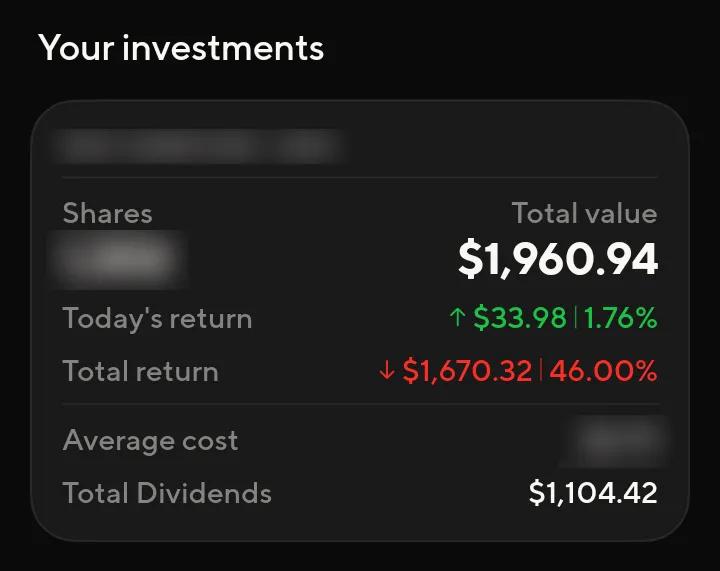
For individual stocks, “share-price erosion” or “capital loss” is usually the more precise term than NAV erosion—NAV really belongs to funds and other products that calculate a net asset value. Either way, the lesson underneath is total return: distributions plus price movement, taxes and risk included, not just whichever number happens to feel good on deposit day.
What I would not oversell
“No fees” needs an asterisk
SoFi doesn’t charge monthly maintenance, minimum-balance, standard overdraft, or inactivity fees on its bank accounts. But the current fee schedule still includes things like a $30 outgoing domestic wire fee, fees on certain instant transfers and international remittances, cash-deposit fees through retail partners, and possible third-party charges at out-of-network ATMs. “No fees” describes the everyday stuff. It does not describe all the stuff.
To be fair to SoFi, none of that makes it unusual. Wire fees and cash-deposit surcharges are close to universal across banks. It’s still worth knowing they exist, since “no fees” as a marketing line invites you to forget the exceptions are there at all—at SoFi or anywhere else.
The no-fee overdraft coverage isn’t unlimited either. The advertised coverage applies to qualifying debit-card transactions up to $50 and currently requires at least $1,000 in eligible direct deposits during the applicable period—so it’s a perk you have to qualify for, not a blanket safety net under every account.
SoFi Invest has its own fine print
Self-directed online trades in U.S. stocks and ETFs currently carry no SoFi commission, but regulatory charges, fund expenses, and other under-the-hood costs can still apply. The fee schedule also lists an outgoing account-transfer fee, an IRA-closing fee, and an inactivity fee after six months without a login. Automated investing currently charges a 0.25% annual advisory fee.
Banking and investing in one place is genuinely convenient. It’s not a reason to skip reading the fee schedule, or to keep your entire financial life parked at one company. Convenience saves you clicks. Spreading accounts across institutions can save you a much worse headache later, on the day one account gets frozen, compromised, or simply unavailable when you need it most.
One more thing worth flagging on its own: don’t assume cash sitting uninvested in a SoFi Invest brokerage account earns a competitive rate. SoFi says cash swept to program banks may earn interest, but its public support page does not state a specific current rate and says the rate can change daily without notice. Check the rate shown on your Apex account statement and compare it with what the same cash could earn elsewhere before letting a large balance sit between trades.
The trading experience doesn’t compare to Robinhood Legend
I’ve mostly stopped opening new investment positions at SoFi. Nothing about it is broken, and I still hold stocks there from before I made the switch—SoFi Invest is a perfectly reasonable place to buy something and not think about it for years. It’s that Robinhood Legend spoiled me, and I genuinely can’t go back to anything else now.
SoFi’s charts are fine for confirming a stock exists and has a price. They’re not built for the moment-to-moment decisions I actually want when timing an entry—telling at a glance whether a stock is worth buying on a dip, dragging a limit order to a new price, watching an order fill without leaving the chart. Legend makes all of that fast, and honestly a little fun. SoFi just isn’t built for that job, and I don’t think it’s trying to be.
If you’re the kind of investor who buys a position and doesn’t sweat the entry price, none of this will matter to you—SoFi Invest will do everything you need. If you want to watch for a dip and act on it, you’ll feel the gap immediately.
Share-lending income is unpredictable
In my own account, SoFi’s stock-lending payments have outperformed Robinhood’s, and not by a small margin: I used to lend out more shares at Robinhood and earn pennies for it, while lending fewer shares at SoFi brings in something like $10 to $14 a month. That is not a controlled experiment—the holdings, borrowing demand, loan duration, and program economics all differ enough that it’s not a fair fight either way. It does mean the size of your position tells you nothing about the size of the check.
SoFi’s program is optional, and you only get paid when shares are actually borrowed by someone else. Loaned shares can lose their voting rights, payments that substitute for dividends may get taxed differently than a qualified dividend would, and the shares may not carry the same SIPC treatment while they’re out on loan. A little passive income showing up in your account is a nice surprise. It still deserves a risk label, not a victory lap.
Who SoFi fits—and who should keep looking
SoFi is a strong candidate if you:
- Receive an eligible direct deposit or naturally meet the qualifying-deposit requirement.
- Prefer an online-first bank and rarely need a branch or frequent cash deposits.
- Want savings buckets, early pay, investing, and everyday banking in one app.
- Will periodically check that the variable rate remains competitive.
It may be a weaker fit if you:
- Regularly deposit cash or need in-person service.
- Cannot meet the rate qualifications.
- Send frequent domestic wires.
- Prefer a bank with a deliberately simple product lineup.
- Might use the investing convenience as an invitation to trade more often than your plan requires.
- Want to actively time investment entries and exits—the charting tools aren’t built for that job.
My practical test before switching
I didn’t move my entire financial life just because the app looked modern. Before committing, I put SoFi through a rough thirty-day trial of my own:
- Opened the account with an amount that felt meaningful but not operationally dangerous if something went sideways.
- Confirmed exactly what qualified me for the advertised rate—not what the ad implied.
- Tested one transfer in each direction.
- Confirmed bill pay, ATM access, alerts, beneficiaries, and customer support actually worked.
- Read the bank and investing fee schedules, the boring ones nobody links to.
- Moved my direct deposit only after the account had proven it behaved the way I expected.
- Kept my old account open long enough to catch any forgotten payments and deposits still trying to find their way home.
That’s the process that got SoFi over the line for me—not a script anyone else has to follow. It got my paycheck to me quickly, gave idle cash a respectable job to do, and presented my dividend results with enough honesty to occasionally hurt my feelings. That’s an unusually productive combination for a finance app to pull off.
For official details, visit SoFi Checking and Savings. That is an ordinary, untracked product link.
Sources and date checked
Product terms checked July 18, 2026. Verify them again before opening or funding an account.
- SoFi banking rate sheet
- SoFi savings account and current new-customer offer
- SoFi Plus membership benefits and math
- How early paycheck access works
- SoFi banking fee schedule
- SoFi banking benefits
- FDIC coverage and the Insured Deposit Program
- SoFi Invest pricing and fees
- SoFi: Do I earn interest through the brokerage cash sweep program?
- How SoFi displays return and dividends
- Share-lending benefits and risks
This review describes my experience and is educational, not individualized banking or investment advice.